

The Scarcity of God
Scarcity is not something we’re trained to value. In a world of endless scrolling, infinite credit, and money created with a keystroke, we’ve grown suspicious of limits. Scarcity feels like a flaw—something to engineer away.
But what if scarcity is the very thing that gives something value?
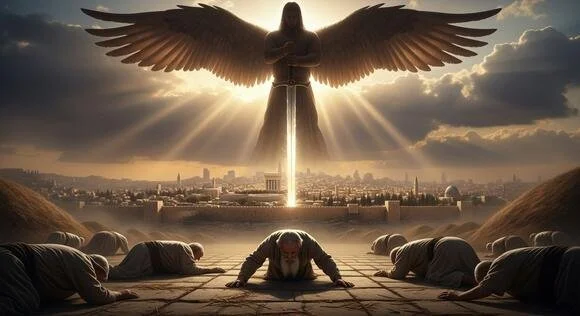
The Bible tells a strange and sobering story about King David that helps us see why. After committing a grave sin, David is given a choice of punishments: famine, war, or a plague sent directly by God. He chooses to fall into God’s hands, trusting in divine mercy rather than human cruelty. The cost is devastating—70,000 lives lost—until God relents.
At the place where the destruction stops, David is instructed to build an altar. The land belongs to a man named Ornan, who generously offers David everything he needs for free: the land, the wood, even the animals for sacrifice.
David refuses.
“I will not offer to the Lord that which costs me nothing.” - 1 Chronicles 21:24
That sentence is the beating heart of this meditation.
David understands something essential: a sacrifice that costs nothing is not a sacrifice at all. If it requires no loss, no restraint, no personal skin in the game, it carries no meaning.
This is where scarcity enters the story—not as cruelty, but as clarity.
We intuitively understand this in economics. Gold has been valuable for thousands of years not because it’s useful in everyday life, but because it’s scarce, difficult to extract, and costly to produce. Bitcoin carries this idea even further. Its fixed supply, proof-of-work, and unchangeable rules ensure that no one can conjure it out of nothing. Every bitcoin represents real energy, real time, and real cost.
Scarcity creates trust.
Now contrast that with modern money. Governments can print currency ex nihilo—out of nothing—and distribute it freely. At first glance, this looks like generosity. But it isn’t. When money is created without cost to the giver, the cost is quietly transferred to everyone else through inflation. Someone always pays. The sacrifice is just hidden.
Which raises a deeper question:
What does real generosity look like?
If giving costs you nothing, is it truly giving?
This question leads us somewhere unexpected—to the nature of God himself.
If God is all-powerful, capable of creating entire galaxies with a word, how can He love in any meaningful sense? Love, by definition, requires sacrifice. Parents sacrifice sleep, comfort, and ambition for their children. Spouses sacrifice autonomy for commitment. Even small acts of love require choosing another’s good over our own convenience.
But for an omnipotent being, nothing is difficult. Nothing is scarce. So how could God ever prove that His love is real?
There is only one thing God could give that would actually cost Him something.
Himself.
This is the scandal and beauty of the Christian story. God does not give at someone else’s expense, the way governments do when they print money. He gives at His own. In Jesus, God enters history, suffers, and dies. Not because He lacked power—but because love without sacrifice is empty.
This is where the idea of scarcity reaches its highest expression. God is not scarce because He withholds Himself. He is scarce because there is only one of Him. He is singular, eternal, and utterly unique. And yet—astonishingly—He makes Himself accessible.
Like the rarest form of value imaginable, God does not cheapen Himself by infinite reproduction. Instead, He offers Himself freely, at immeasurable cost.
David refused to offer a sacrifice that cost him nothing.
God refused to love us in a way that cost Him nothing.
In a world drowning in abundance and counterfeit generosity, this truth cuts through the noise:
What is most valuable is not what is easiest to obtain, but what is most costly to give.
Scarcity, it turns out, is not the enemy of love.
It is the proof of it.
